AI readiness has a maintenance problem
Who keeps enterprise information ready for AI once the launch team moves on?
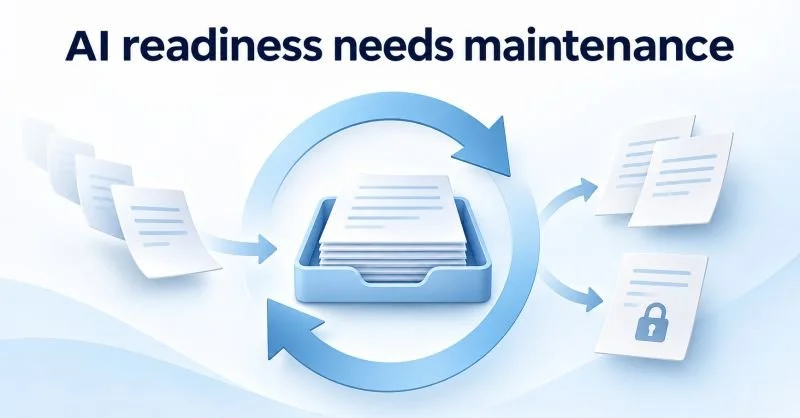
One of the most useful questions to ask before an AI launch is who will keep the information ready afterwards. A successful launch demonstrates readiness at a point in time. The information supporting it will continue to change.
New files arrive, guidance is revised and teams create fresh copies of existing material. Maintaining a useful information foundation needs clear responsibilities and a repeatable preparation process.
What changes after launch?
Consider an illustrative example. A team prepares a collection of procedures and client information for an internal AI assistant. It checks readability, resolves conflicting versions and removes personal details that the intended tasks do not need.
A month later, revised guidance arrives, another copy of an old procedure is uploaded and a new client file includes personal details. The original preparation work does not automatically establish whether these additions are appropriate.
The practical question becomes: how will the organisation identify changes, decide what needs attention and check that the prepared information still supports the intended work?
Agree five responsibilities before handover
The following is a practical approach for enterprise teams and managed service providers to agree together.
- Ownership. Name a business owner who can decide which information is current and appropriate. Define where IT and delivery partners support that decision, and who acts when the owner is unavailable.
- Triggers. Check new or changed information alongside scheduled reviews. Agree which changes require another check, such as revised guidance, a new source or a different audience for the output.
- Preparation. Check readability, resolve duplicate versions and apply agreed rules for personal and sensitive content. Keep required records in line with retention obligations while deciding which versions belong in the AI knowledge source.
- Validation. Test representative questions and inspect the sources behind the answers. Review whether the response uses current guidance, preserves necessary context and handles sensitive details appropriately.
- Exceptions. Give unresolved conflicts a clear owner and a route to resolution. Agree what happens to affected information while a decision is pending, rather than leaving uncertainty with the launch team.
Make maintenance part of the service handover
For clients and MSPs, these responsibilities should be explicit in the handover. A useful maintenance plan states who checks what, how often and what evidence shows that the checks worked.
Start with one important workflow. Record its approved sources, information owner, preparation rules and representative test questions. Keep a short record of issues found, decisions made and validation results. This gives the next review a clear starting point.
The review frequency should reflect how quickly the information changes and the consequences of an incorrect answer. A change to a critical procedure may justify an immediate check even when a scheduled review is still weeks away.
Keep the information foundation useful
Software can support preparation, but business owners still need to decide what is authoritative and appropriate. AIAssure helps prepare enterprise information through Optimise, which makes information readable and removes duplicate and unnecessary files, and Cleanse, which identifies and removes personal and sensitive content.
Those preparation tasks belong within an ongoing process of ownership, review and testing. Who owns that responsibility in your organisation once the launch team moves on?
Adapted from Stewart Connors’ LinkedIn post. Read the original post ↗
← Explore more Articles & InsightsLet’s build a more confident AI future, together.
Discover how AIAssure can help your organisation get more value from AI.
Book a Demo