From assessment to accountable action: why government data quality guidance matters
Why the government’s data quality action-plan guidance matters for ownership, remediation and measurable AI readiness.
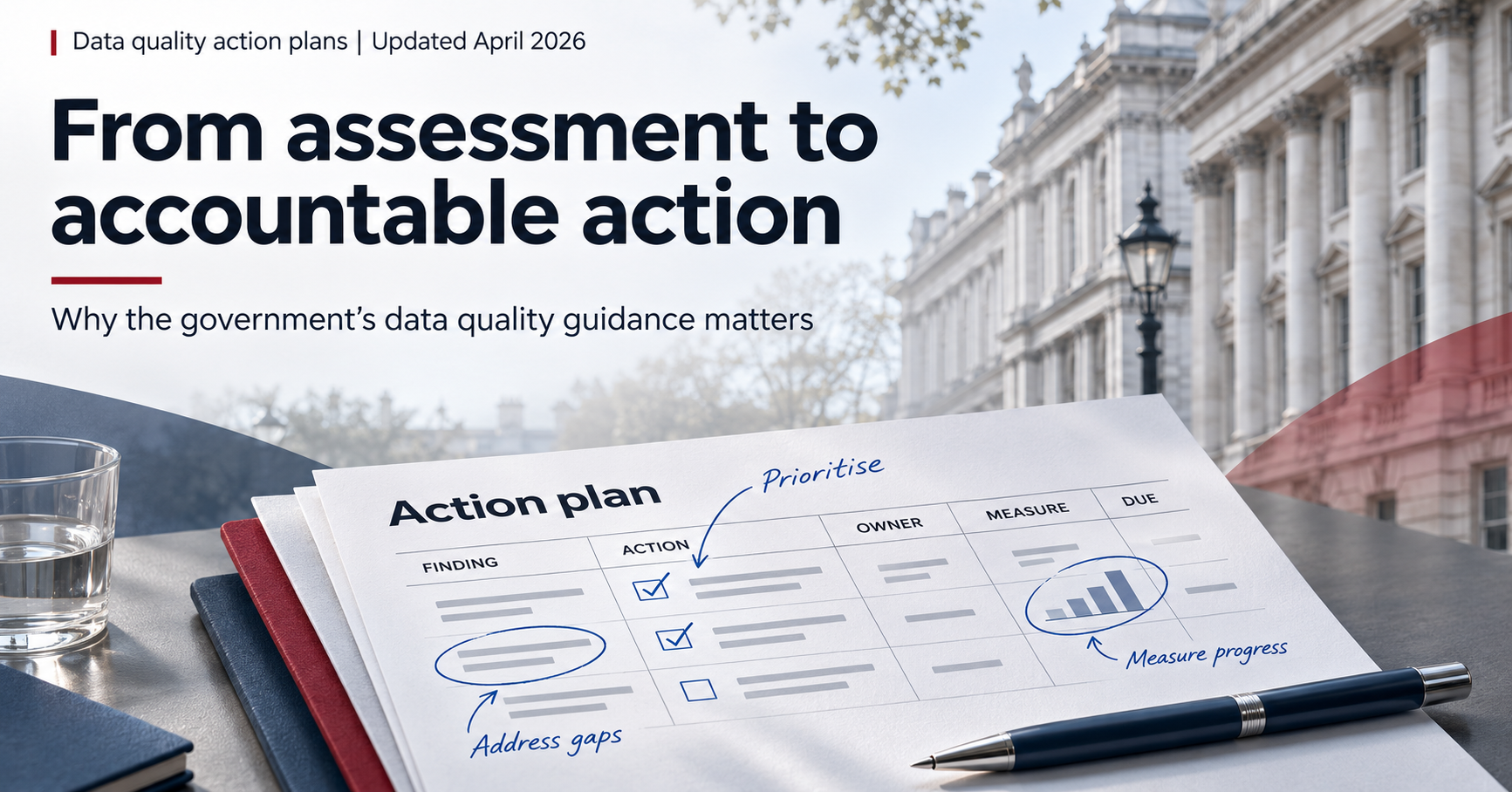
The UK government’s guidance on implementing a data quality action plan, updated on 16 April 2026, addresses a challenge that deserves more attention in AI projects: what happens after the assessment?
The guidance connects quality assessment with corrective action, named responsibility, improvement targets and continued monitoring.
For me, its importance lies in making improvement something an organisation can manage and demonstrate.
A finding is not a fix
An assessment might identify duplicate records, conflicting guidance or missing information.
But a list of findings does not tell the business which issue matters most, who will resolve it or what evidence will show that the work succeeded.
Consider an illustrative example: an internal assistant returns conflicting instructions from two versions of a procedure.
The assessment flags the problem. Yet the conflict remains because nobody has authority to decide which procedure should take precedence.
The technical team has identified the issue. The organisation still needs to make a decision.
Address the cause, not just the immediate problem
One of the strongest elements of the government guidance is its emphasis on root causes. It asks organisations to assign responsibility for resolving them, with target dates, rather than repeatedly treating the symptoms.
My interpretation for an AI project would be to examine why conflicting procedures accumulated.
Was the publishing location unclear? Were approval responsibilities undefined? Did teams keep creating local copies because the official source was difficult to find?
Removing one file may address today’s conflict. Changing the process could help prevent it returning.
That distinction matters to budgets, delivery times and confidence in the information people use.
What should an actionable handover contain?
For an enterprise AI workflow, I would want each priority issue to have:
- A clear explanation of the business consequence.
- A named owner with authority to approve the resolution.
- A specific action and completion date.
- An agreed test for closing the issue.
- A plan for detecting recurrence.
These are my suggested handover requirements, informed by the government’s approach.
The 2025 AI Playbook reinforces the wider point: evaluation should continue through development and operation. A completed clean-up task and a verified improvement in AI behaviour are related, but they need separate checks.
The impact depends on follow-through
I believe this guidance can help leaders turn an abstract concern about “poor data” into prioritised work with visible results.
For delivery partners, it also provides a useful basis for clarifying where assessment ends, who owns remediation and how improvement will be measured.
When your next readiness assessment arrives, will it produce an owned action plan—or another list of unresolved observations?
Government references: Implementing a data quality action plan ↗ · AI Playbook for the UK Government (2025) ↗. Independent commentary; the scenario is illustrative.
← Explore more Articles & Insights