Which version is your AI using?
A practical readiness check for approved sources, conflicting copies and more reliable AI answers.
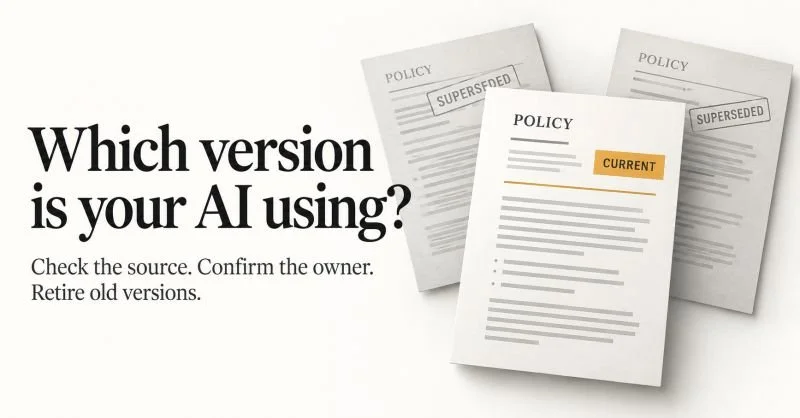
An AI answer can cite a source and still point your business in the wrong direction. If the source is a superseded policy, an unapproved draft or a proposal that no longer reflects your offer, a citation alone is not enough.
For IT leaders and AI implementation partners, a useful starting question is: which version should we trust? Answering it helps connect information preparation to a practical business outcome.
Current does not always mean authoritative
A recent edit date can help you investigate a source, but it does not prove that the content is approved. An older policy may still be the authorised version, while a file updated yesterday may be a working draft.
Before expanding an AI rollout, agree which information should support the intended workflow. Identify the owner who can confirm its status and resolve disagreements. This gives the project a clear reference point when testing an answer.
Start with one important workflow
Choose a business question that people genuinely need answered: an employee checking a policy, a sales team preparing a proposal or a service team looking for approved guidance.
Then review the information that the assistant could use:
- Approval and ownership: which source is approved, and who is responsible for keeping it reliable?
- Conflicting copies: where do duplicate versions contain different instructions or claims?
- Current and historical material: can the business distinguish guidance for use today from information kept for reference?
- Retrieval in practice: does the assistant find the approved source when tested by someone with the intended access?
This is a concrete readiness check that business owners and technical teams can review together. It tests what the assistant actually finds, alongside what the organisation intends it to use.
Retain what is needed and manage what AI can use
Historical information can have a legitimate purpose. Keep material that must be retained, and manage its availability to AI in line with retention obligations and business needs.
Removing every older file is not a reliable way to establish authority. The important task is to make deliberate decisions about the information available for a particular use case and clearly distinguish approved guidance from other material.
Prepare, resolve and test again
Once conflicts have been resolved, repeat the original question. Check the source retrieved, whether it is the approved version and whether the answer reflects it accurately. Include cases where the right response is to acknowledge missing or conflicting information.
AIAssure prepares enterprise information before AI uses it. Optimise makes information readable and removes duplicate and unnecessary files. Cleanse identifies and removes personal and sensitive information before AI uses it.
That preparation supports more reliable AI results, helps reduce hallucination and information exposure risks, and saves information preparation time. Information owners still need to decide which sources are authoritative, and important outputs still need testing and verification. Better information cannot eliminate hallucinations.
Before adding another information source to your AI project, ask: who decides which version the AI should rely on?
Adapted from Stewart Connors’ LinkedIn post. Read the original post ↗
← Explore more Articles & InsightsLet’s build a more confident AI future, together.
Discover how AIAssure can help your organisation get more value from AI.
Book a Demo